A golf club distance chart only helps once it starts from your own numbers. Type your 7-iron carry below for an estimate across 11 clubs. For comparison, Shot Scope's 15-handicap men average 154 yards with a 7-iron and 236 with a driver.
How to use the golf distance calculator
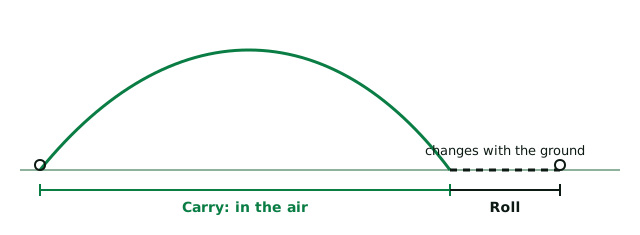
- Use a normal 7-iron, not your best one. Carry is how far the ball flies before it lands. Enter the distance you'd expect from a decent strike on an ordinary day.
- Read down the bag. You get an estimated carry for each club from driver to pitching wedge.
- Check the longest clubs first. That's where the estimate is least reliable, so measure those before you trust them over water.
- Press Reset to clear your number. It's kept in your own browser between visits and never sent to us.
How the club distance calculator works, with a worked example
There's one sum: your 7-iron carry × the club's ratio = that club's estimated carry. Each ratio is that club's PGA Tour carry divided by the tour 7-iron carry of 176 yards, from the Trackman averages published by Golf Monthly. So the driver ratio is 282 ÷ 176 = 1.602. Put in 176 and the tool gives back Trackman's numbers exactly.
| Club | PGA Tour carry (yards) | Ratio | If your 7-iron carries 140 |
|---|---|---|---|
| Driver | 282 | 1.602 | 224 |
| 3-wood | 249 | 1.415 | 198 |
| 5-wood | 236 | 1.341 | 188 |
| Hybrid | 231 | 1.312 | 184 |
| 4-iron | 209 | 1.188 | 166 |
| 5-iron | 199 | 1.131 | 158 |
| 6-iron | 188 | 1.068 | 150 |
| 7-iron | 176 | 1.000 | 140 |
| 8-iron | 164 | 0.932 | 130 |
| 9-iron | 152 | 0.864 | 121 |
| Pitching wedge | 142 | 0.807 | 113 |
A golfer carrying a 7-iron 140 yards with a shot of 158 to the pin would look at the 5-iron. That's the starting point. What's in front of the green should then move you up or down a club.
How close does the estimate get?
Tour ratios might not suit club golfers, so we put Shot Scope's 15-handicap 7-iron of 154 yards through the sum and compared the answers with that group's real figures.
| Club | Calculator | Shot Scope, 15 handicap | Difference |
|---|---|---|---|
| Driver | 247 | 236 | +11 |
| 4-iron | 183 | 186 | -3 |
| 5-iron | 174 | 169 | +5 |
| 6-iron | 164 | 162 | +2 |
| 8-iron | 144 | 146 | -2 |
| 9-iron | 133 | 136 | -3 |
The irons land within 5 yards, which is close enough to plan with. The driver runs 11 long, so don't lean on the calculator for a tee shot that has to reach a fairway. Only Shot Scope's 7-iron is reported as carry. MyGolfSpy lists the other irons simply as distance and Golf Monthly's driver figure isn't labelled either, so treat this as a rough check.
Golf club distance chart by handicap
These average golf club distances are Shot Scope's "performance average", which strips out big mishits. Golf Monthly reports the 7-iron column as carry. The rest come from its iron chart on MyGolfSpy and Golf Monthly's driver table.
| Handicap (men) | Driver | 4-iron | 5-iron | 6-iron | 7-iron | 8-iron | 9-iron |
|---|---|---|---|---|---|---|---|
| Scratch | 285 | 223 | 200 | 185 | 178 | 166 | 155 |
| 5 | 261 | 201 | 183 | 172 | 164 | 153 | 139 |
| 10 | 259 | 199 | 187 | 171 | 161 | 150 | 140 |
| 15 | 236 | 186 | 169 | 162 | 154 | 146 | 136 |
| 20 | 225 | 169 | 162 | 151 | 146 | 138 | 129 |
| 25 | 204 | 151 | 143 | 137 | 132 | 122 | 108 |
| Handicap (women) | Driver | 7-iron |
|---|---|---|
| Scratch | 252 | 149 |
| About 5 | 235 | 138 |
| About 10 | 226 | 126 |
| About 15 | 199 | 119 |
| About 20 | 188 | 107 |
| About 25 | 178 | 103 |
| About 30 | 166 | 98 |
Shot Scope's women's driver figures come in bands such as 1 to 5 and 26 plus, so we've lined them up with the nearest 7-iron handicap. Golf Monthly gives the women's 7-iron figures as average carry, without saying whether big mishits are removed.
How far golfers hit each club by age
The Arccos chart on MyGolfSpy covers more than 30 million shots from 2025 to 2026. These are total distances, so roll is included. Mishits stay in too, which is why they read shorter.
| Men, average total yards | 30s | 40s | 50s | 60s | 70s |
|---|---|---|---|---|---|
| Driver | 236 | 232 | 221 | 208 | 191 |
| 5-iron | 152 | 150 | 145 | 138 | 127 |
| 7-iron | 139 | 136 | 132 | 126 | 115 |
| 9-iron | 123 | 121 | 116 | 109 | 99 |
| Pitching wedge | 108 | 106 | 101 | 95 | 86 |
| Sand wedge | 75 | 74 | 72 | 69 | 64 |
| Women, average total yards | 30s | 40s | 50s | 60s |
|---|---|---|---|---|
| Driver | 195 | 186 | 174 | 166 |
| 7-iron | 110 | 104 | 98 | 94 |
| 9-iron | 100 | 94 | 88 | 82 |
| Pitching wedge | 87 | 83 | 76 | 72 |
| Sand wedge | 63 | 61 | 59 | 58 |
Average driving distance: why three sources disagree
This is the bit most charts skip. The same kind of golfer can get three different answers, because each source measures something different.
| Source | What it counts | Driver | 7-iron |
|---|---|---|---|
| Shot Scope, 15 handicap | Tracked shots, big mishits removed | 236 | 154 |
| Arccos, men in their 40s | Tracked shots, mishits kept, all handicaps | 232 | 136 |
| R&A, 13 to 20 handicap | Drives measured at six UK venues | 200 | Not measured |
The R&A figure is the only one here measured on UK courses by someone other than the player's own device, using six venues usually visited once a year between May and September, so treat it as a summer number from real club golf. It counts total distance with 88% of those tee shots hit using a driver, so it isn't a pure driver figure. Women in the same report averaged 148 yards across 2013 to 2019. It's older. It's also the most sobering number on this page.
Plan your scoring clubs from a tracked figure with mishits removed. Then remember that your real average, bad shots included, may sit nearer the Arccos column: 18 yards shorter on the 7-iron in this table. Shot Scope's data shows high-handicap golfers finish short of the green 46% of the time from around 100 yards and 95% of the time from 200 yards or more. If you're between clubs with trouble at the front, take the longer one.
Why your own numbers won't match the chart
The number on the club isn't the loft
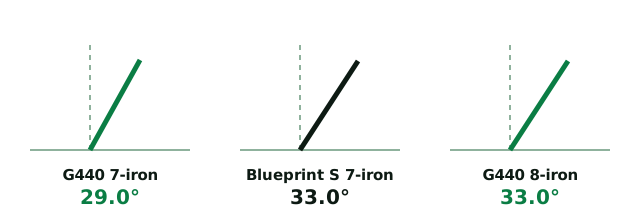
Ping's own specs show this neatly. The G440 7-iron has 29.0° of loft, while its Blueprint S 7-iron has 33.0°. That's the same loft as the G440 8-iron. So two golfers comparing 7-irons can be a full club apart before anyone swings. Check your maker's spec page before you judge yourself against any golf yardage chart.
A British winter takes yards off every club
Andrew Rice's Trackman work, reported by GOLF.com, found about 2 yards lost on each club for every 10°F drop below 75°F. Now add UK weather. Met Office averages for Heathrow give a daytime high of 23.9°C in July and 8.4°C in January, a drop of about 28°F. That's about 6 yards a club at the warmest part of the day. At Charterhall in the Scottish Borders, it's 19.5°C and 6.2°C, or about 5 yards.
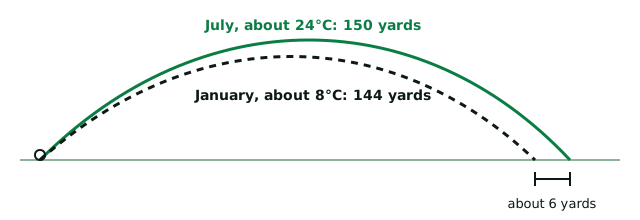
Six yards is more than half the roughly 10-yard gap MyGolfSpy describes between most irons at 15 handicap. GOLF.com also points out that softer ground reduces roll. So keep a summer set of numbers and a winter set. Remember that the R&A's UK drives for men were measured between May and September.
Age, strike and shaft
Arccos shows men's 7-iron distance slipping from 139 yards in their 30s to 115 in their 70s. The top of the bag also gets crowded as speed falls. In the 60s column, the 5-wood, 7-wood and 3-hybrid all average 146 yards. If two of your clubs do the same job, one could make way for a higher-lofted wood or hybrid. A fitter can also check your shaft flex and loft against your swing speed.
How far should I hit a 7 iron and how do I find out?
For a 15-handicap man, 154 yards is Shot Scope's figure. For a 15-handicap woman, it's 119. But your own number is what picks the right club, so measure it:
- Warm up, then hit 10 balls with one club at a range with a launch monitor. Drop the best and worst, then average the rest.
- Repeat for every club in your bag, starting with the 7-iron so you can compare it with the calculator.
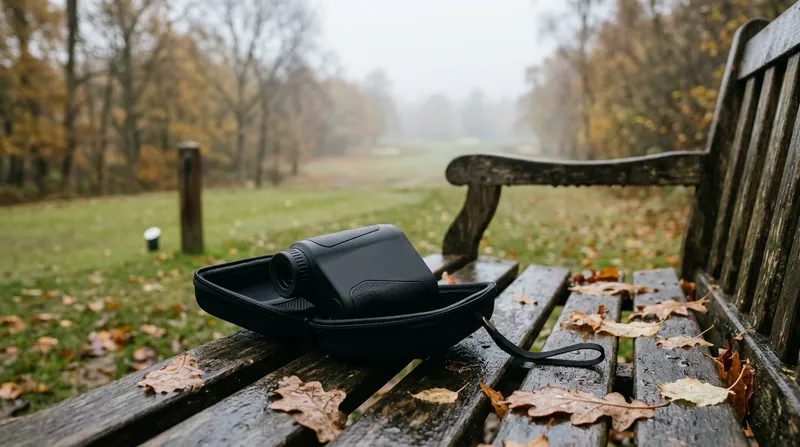
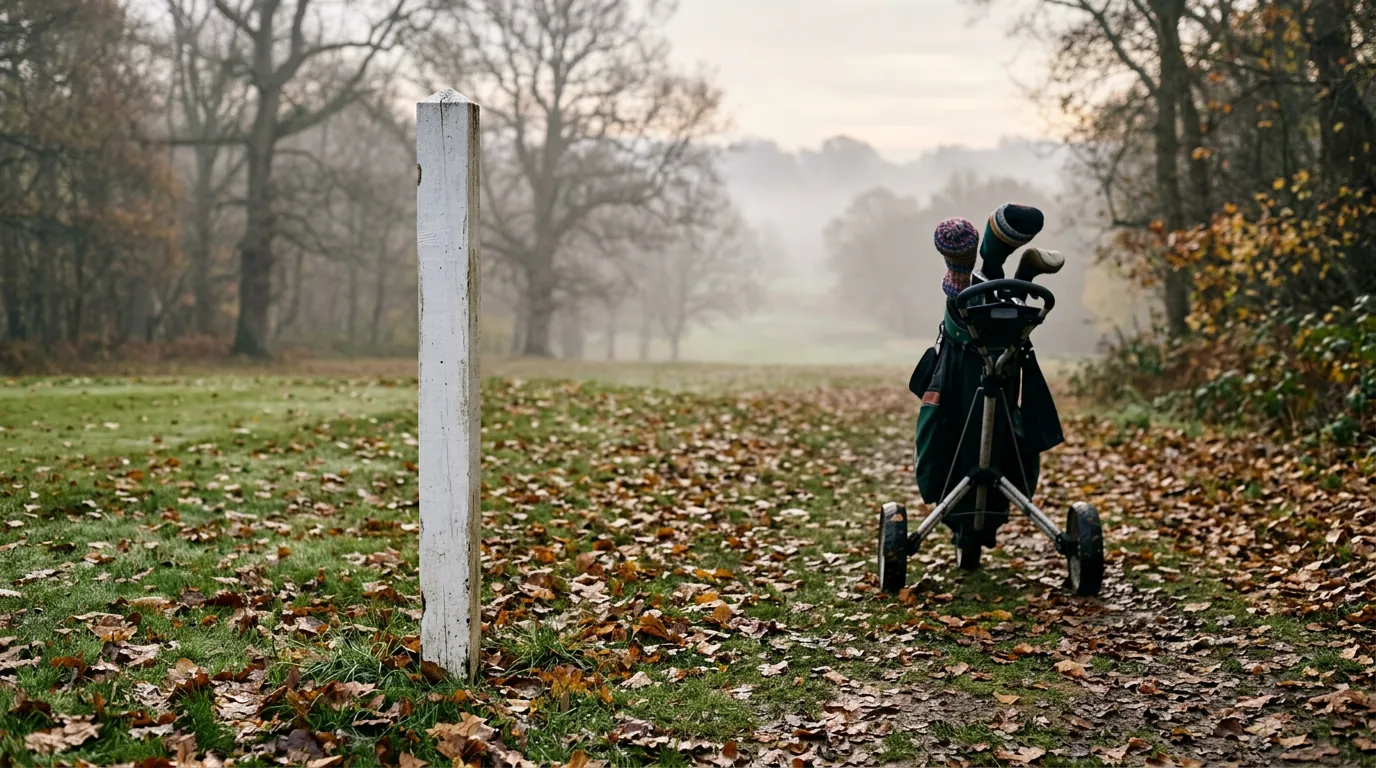
- Check on the course. On a quiet hole, leave your bag where you hit from, then use a laser rangefinder from your ball to measure back to it. That gives total distance, not carry.
- Write down carry and total for your longer clubs, then repeat in winter.
- Look for clubs less than about 5 yards apart and any gap of 20 yards or more. Those are the ones to fix.
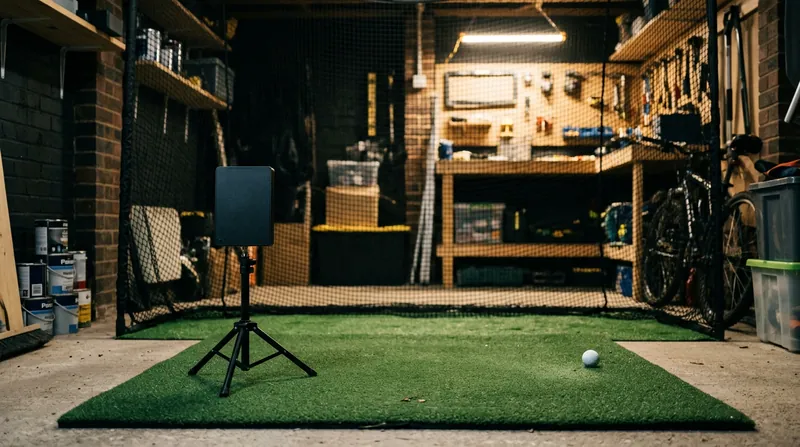
Want to own the data? Our guide to the best launch monitors compares portable units that report carry. If you'd rather practise indoors, the home golf simulators guide and the simulator room and cost planner show what that takes. Our other free golf tools can then help with handicap and scoring.
The short version
- Use this chart to find your starting point, then replace it with measured numbers.
- Pick your club from carry, not total distance, when anything has to be flown.
- Take about 6 yards off a summer number for a British January.
- Compare loft before you compare 7-irons with your mates.
The limits of this tool
- It's an estimate from one club, using tour ratios. It can't see your strike, shaft or lofts.
- It stops at the pitching wedge, because the Trackman table does. Arccos data suggests the highest-lofted wedges are often played to a number rather than at full power.
- It works in yards. For metres, multiply by 0.9144, so 150 yards is about 137 metres.
- It doesn't allow for wind, slope or altitude.
Your questions answered
What is a good distance for a 7-iron?
Shot Scope's averages run from 132 yards at 25 handicap to 178 at scratch for men. For women, they run from 98 yards at 30 handicap to 149 at scratch. A good number is one you can repeat, because that's what lets you pick the right club.
What is the average driving distance for a club golfer in the UK?
The R&A measured 216 yards for UK male club golfers in 2019, with an average handicap of 10.8, in a report published with the USGA. Women averaged 148 yards across 2013 to 2019. Trackers report longer figures for similar golfers, partly because they count different shots.
Should I use carry or total distance?
Use carry when the ball has to clear something or land on a green. Total is useful for lay-ups and tee shots where you want to know whether the ball could run into trouble.
Why does the chart show a 10 handicap hitting a 5-iron further than a 5 handicap?
These are averages from different groups of golfers, so they aren't perfectly smooth. Shot Scope shows 187 yards at 10 handicap and 183 at 5. Treat a few yards of difference between neighbouring rows as noise.
How much distance do you lose in winter?
Trackman work by coach Andrew Rice suggests about 2 yards a club for every 10°F below 75°F. With Met Office averages for Heathrow, that's about 6 yards between July and January, before you count the lost roll on soft ground.
Do older golfers need different clubs?
Not automatically, but Arccos shows long clubs bunching together as golfers age. If your long iron and hybrid go the same distance, a higher-lofted wood or hybrid may give you a more useful gap. A fitting can confirm it.
Where these facts came from
- Trackman PGA Tour carry by club, the basis of the calculatorchecked 4 November 2026
- Shot Scope 7-iron carry by handicap for men and the misses-short figureschecked 4 November 2026
- Shot Scope driver distance by handicap for men and womenchecked 4 November 2026
- Shot Scope 7-iron carry by handicap for womenchecked 4 November 2026
- Shot Scope 4-iron to 9-iron distances by handicapchecked 4 November 2026
- Arccos distances by age for men and womenchecked 4 November 2026
- Measured UK driving distances by handicap and how they were collectedchecked 4 November 2026
- Andrew Rice's Trackman work on temperature and carrychecked 4 November 2026
- Softer ground reducing roll in cooler weatherchecked 4 November 2026
- Heathrow average daytime highs, 1991 to 2020checked 4 November 2026
- Charterhall average daytime highs, 1991 to 2020checked 4 November 2026
- Ping G440 iron loftschecked 4 November 2026
- Ping Blueprint S iron loftschecked 4 November 2026
Spotted something out of date? Tell us and we'll fix it.