If you buy through our links we may earn commission, at no cost to you. How we choose and our disclosure
The best remote control golf trolley for most UK golfers is the Motocaddy ME Remote: 100m+ range, automatic downhill control and a handle mode at an entry-level price. Choose the Stewart Vertx Remote for steep ground, the Motocaddy M7 GPS Remote for a hole map and the Alphard Cybercart for side slopes.
Every spec here comes from the maker, every price from a UK retailer or maker page opened on 3 November 2026 and every "on the course" comment from a named independent tester. Our how we choose page sets out the method. A golf trolley with remote is one of the dearest buys in our wider guide to golf gadgets worth owning, so the sums below are worth five minutes.
Four things most remote trolley guides skip
- Quoted weights aren't like for like. Stewart and PowaKaddy leave the battery out, which adds up to 3kg to the lift.
- Motocaddy's 36 hole battery claim is for single-motor trolleys. Its own battery page says 18 holes on twin-motor models, including its remotes.
- Going hands-free costs about 80p a round over a standard Motocaddy, plus 3.8kg every time you lift it.
- Testers say the Stewart Vertx and the Alphard Cybercart have no ordinary handle mode. If the handset fails, you're pushing.
The best remote control golf trolley for each type of golfer
| Best for | Remote golf trolley | Why it's here | Know this first |
|---|---|---|---|
| Most golfers | Motocaddy ME Remote | Downhill control, 100m+ range, handle mode | Drifts on side slopes |
| Steep courses | Stewart Vertx Remote | Golf Monthly's best overall, holds its speed up and down | No handle mode, no GPS |
| Built-in GPS | Motocaddy M7 GPS Remote | Hole maps with no subscription | Pointless if you own a good GPS |
| Biggest screen | PowaKaddy RX12 GPS | 5-inch portrait touchscreen | 50m range, needs input on slopes |
| Side slopes | Alphard Cybercart | Gyroscope holds its line across a hill | 18kg, big when folded |
| Gyroscope for less | MGI Zip Navigator AT | Straight tracking at a mid-range price | One of the bulkiest folds here |
| Follow and remote | Stewart Q Follow | Walks behind you or takes the handset | Heaviest lift with the big battery |
| Lowest price | Navee Birdie 3 | Cheapest purpose-built remote here | Beeps you can't turn off |
How do you choose a remote control golf trolley?
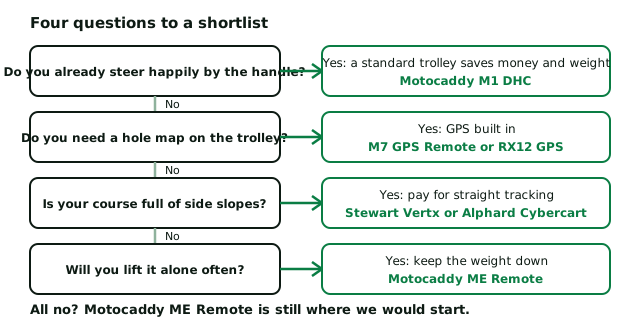
Four questions settle this for nearly everyone. Answer them in order, because each one rules out more than the next.
Do you need a remote at all?
A remote lets you walk to your ball while the trolley goes somewhere else, such as round a bunker to the next tee. If you normally walk beside your clubs, a standard electric trolley with a send-ahead function does most of that for less. Our guide to the best electric golf trolleys covers those. Here's the sum against the closest standard model.
| Checked 3 Nov 2026 | Motocaddy M1 DHC | Motocaddy ME Remote | Difference |
|---|---|---|---|
| Price with the ULTRA battery | About £850 | About £999 | About £149 |
| Weight Motocaddy quotes | 10.6kg | 14.4kg | 3.8kg |
| Per round, 37 rounds a year for 5 years | £4.59 | £5.40 | 81p |
So the money is the small part. The extra 3.8kg is what you'll notice every time the boot opens.
What does remote range mean on a real hole?
Range tells you how far you can be from the trolley and still control it. Most of the time you'll use a fraction of it, because you want your clubs near your ball. It matters when you stand on a green and send the trolley to the next tee.
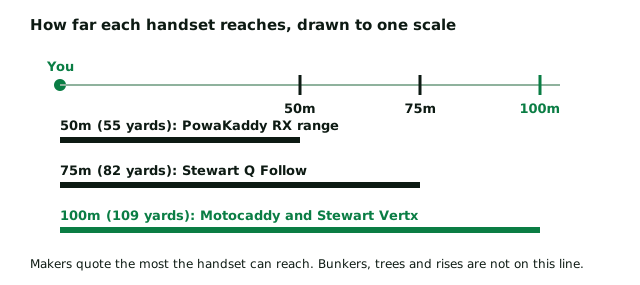
Be wary of range figures in shop lists and blogs, because some don't match the makers. Alphard doesn't quote a range for the Cybercart, though it says the handset stops the trolley when out of range. Today's Golfer's tester says that range isn't the longest and sometimes had to be about 20m away. MGI's page doesn't give one for the Zip Navigator AT either. Navee quotes up to 200m for its app, not its handset.
How much will you really lift?
This is where spec sheets mislead. Stewart quotes the frame and battery apart. PowaKaddy quotes without the battery. Motocaddy doesn't say either way. The bars show the most you could lift in one go, based on what each maker or retailer lists.
Taking the battery off first helps: on a Vertx with the larger battery, that's 14.6kg and 3kg as two lifts. Stewart also builds in a carry handle, which Golf Monthly singled out as something rivals should copy. Then check the box, not only the weight. The RX12 folds to 805mm long, while the Vertx is just 540mm long but 600mm wide. Measure your boot both ways.
Will it hold a line across a slope?
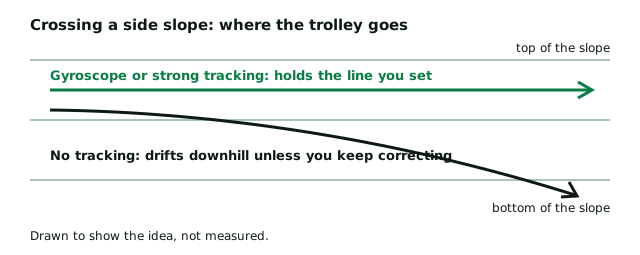
Without straight tracking, a trolley crossing a side slope drifts downhill and you keep correcting it with the handset. Each maker uses its own name for the fix, so here's what they're called next to what testers found.
| Trolley | The maker's system | What a tester found | Handle mode? |
|---|---|---|---|
| Stewart Vertx Remote | Active Terrain Control, shifts power between motors | Golf Monthly, 2023: the most control that tester had felt in a remote that year | No, freewheel push only |
| Alphard Cybercart | 6-axis gyroscope | Golf Monthly: holds your line across any gradient with no corrections | No, freewheel push only |
| MGI Zip Navigator AT | Gyroscope Straight Tracker | Today's Golfer: extremely stable on a wide range of terrains | Yes |
| Motocaddy M7 GPS Remote | Adaptive Terrain Stability on the 2026 model | Golf Monthly's 2025 test: still needs some input across a hill | Yes |
| Motocaddy ME Remote | Adaptive Terrain Stability | Golf Monthly: drifts on side slopes. National Club Golfer: stability very impressive | Yes |
| PowaKaddy RX12 GPS | Slope Traverse Assist | Golf Monthly: needs more attention on slopes than some rivals | Yes, by the handle controls, says Golf Monthly |
| Navee Birdie 3 | None listed | Golf Monthly: constant corrections on side slopes | Yes, push to start |
Golf Monthly's M7 comment comes from 2025, on the previous model. Motocaddy lists Adaptive Terrain Stability on the 2026 version. We couldn't find an independent side slope test of the 2026 M7 GPS.
Our eight remote control golf trolley picks
Best for most golfers: Motocaddy ME Remote
Golfers trying a remote for the first time on normal parkland or gentle hills.
This has what you'd use every round and skips the rest. There's a USB-C rechargeable handset with forward, left, right and reverse, Motocaddy's stated 100m+ range, automatic downhill control and nine speeds. A retractable anti-tip wheel stays attached when you fold it. Grab the handle and use the dial to drive it like a normal electric trolley.
Golf Monthly's review calls it the best entry-level remote electric trolley on the market, praising the battery that charges in the frame and the compact fold. National Club Golfer tried it on a hilly course and rated its stability, though it found the trolley crept forward slightly when left on a severe slope.
- Works by remote or by handle, with no setting to change
- Battery can stay on the trolley to charge
- Lower quoted weight than most picks here
- Golf Monthly found it drifts on side slopes, so keep an eye on it.
- LED indicators only. There's no screen for speed or distance.
- Register the battery within 45 days to get the 60 months of cover.
Best for steep courses: Stewart Vertx Remote
Keen walkers on hilly courses who only want to think about their golf.
Built in Gloucestershire, the Vertx is Golf Monthly's best overall remote. Its Active Terrain Control watches the power to each motor, so the trolley keeps the same speed uphill or downhill without you touching anything. Two wide front wheels replace the usual swivel wheels. Golf Monthly's review found that made it more stable and just as easy to steer.
Choose the battery with care. Stewart's FAQ gives 230Wh, 307Wh and 384Wh rather than holes, because it says every course differs, though its product intro still mentions a 45-hole battery. It also advises a cart, staff or tour bag of 13kg to 15kg and says lightweight stand bags aren't recommended, because they can affect the stability.
- Smallest folded box here, with a carry handle
- 100m range, three cruise control speeds
- Stewart says it's built for wet weather play
- No handle mode. A flat battery means freewheel pushing, which Stewart calls a failsafe.
- No screen or GPS. Battery status shows in the app.
- This is Stewart's Black Friday price for the base battery in black, about £300 under list. Other colours and batteries cost more.
- The Golf Monthly review dates from 2023.
Best with built-in GPS: Motocaddy M7 GPS Remote
Golfers without a GPS device who play away courses and want one thing to charge.
A 3.5-inch touchscreen covers more than 40,000 courses, with full hole maps, a movable target and 3D flyovers. Motocaddy says mapping and performance tracking are free for life. Golf Monthly's M7 review confirms no subscription is needed for hole maps. Today's Golfer names it the best trolley overall after testing over 50 models.
Golf Monthly's tester preferred its remote handling to the RX12's, while placing it just behind the Stewart Vertx. If you already own a watch, look at our GPS watch guide first. The M7 Remote drops the maps for less.
- Handle mode for when you'd rather steer
- AED locator and CPR instructions, where available
- Free Accessory Station with the trolley, says Motocaddy
- Half a kilo heavier than the ME Remote.
- Screen is smaller than the RX12's.
- Bluetooth alerts and performance tracking need a compatible phone and app. Uploading stats needs Wi-Fi.
Best screen: PowaKaddy RX12 GPS
Golfers who care most about the hole map and play gentle courses.
The 5-inch portrait touchscreen is the point here. PowaKaddy says it's the largest on the market, with over 40,000 courses and a full hole view. Golf Monthly's RX12 review calls the screen superb.
The same review is honest about the rest: it needs more attention on slopes than some rivals, as the swivel front wheels often veered off in the direction of the hill. So buy this for the map rather than the driving.
- Biggest screen we found on a remote trolley
- Slim handset that docks under the handle
- One-click fold, with a low 345mm depth
- 50m range, half what Motocaddy and Stewart quote.
- PowaKaddy's page lists no downhill braking and Scottsdale lists no electronic braking, though its feature text mentions optional EBS. Ask before buying for steep courses.
- Scottsdale's summary says 9kg and 560mm wide. PowaKaddy and Scottsdale's own description say 14kg and 425mm, so we've used those.
Best on side slopes: Alphard Cybercart
Golfers on cambered courses with a strong back and a big boot.
Everything about this trolley is large. That's part of why it works. Golf Monthly's review says the low centre of gravity and gyroscope keep it on the line you set across any gradient, with no corrections. It rates the remote experience second only to Stewart's. An automatic parking brake and downhill speed control are listed by Alphard, while the cup holder, umbrella holder, scorecard holder and sand bottle holder come as standard.
- Tracks straight without corrections, says that tester
- Lots of accessories in the box
- Stops itself when out of range, says Alphard
- 18kg, which Golf Monthly calls the heaviest of any remote on the market.
- Today's Golfer notes it can't run as a normal electric trolley, only by remote or freewheel.
- Today's Golfer's tester says the handset range isn't the longest.
- Wheels need fitting by hand out of the box. Golf Monthly also says the looks take some getting used to.
Best follow and remote: Stewart Q Follow
Golfers who dislike holding a handset and want both options.
The Q Follow walks behind you tracking a signal you carry, or you can switch to remote mode up to 75m away. Today's Golfer picks it as its best follow model and praises how responsive it is, with one dry warning: it'll follow you wherever you walk. Golf Monthly's tester of a different trolley, the Navee Birdie 3X, was less keen on follow mode over bridges and around deep bunkers. It folds to the same small box as the Vertx.
- Hands-free walking between shots
- Two cruise speeds and an integrated carry handle
- Dearest Stewart here and 15.2kg before the battery.
- Stewart lists Follow and Remote modes, with freewheel as a failsafe. Today's Golfer says you can also clip the remote above the handle and steer by hand.
- Stewart doesn't list Active Terrain Control on this model. For the steepest ground, look at the Vertx.
What does a remote golf trolley cost per round?
The sums take each checked price and divide it by rounds played over five years. The last column uses the 37 rounds a year that BRS Golf reported for the average club member in 2022. Golf Monthly's trolley tester puts the lifecycle at 7 to 10 years, so five years is a cautious figure.
| Trolley | 15 rounds a year | 37 rounds a year |
|---|---|---|
| Navee Birdie 3 | £11.32 | £4.59 |
| Motocaddy ME Remote | £13.32 | £5.40 |
| MGI Zip Navigator AT | £13.99 | £5.67 |
| Stewart Vertx Remote | £14.65 | £5.94 |
| Alphard Cybercart | £16.65 | £6.75 |
| Motocaddy M7 GPS Remote | £17.33 | £7.03 |
| Stewart Q Follow | £19.32 | £7.83 |
| PowaKaddy RX12 GPS | £19.99 | £8.10 |
Prices checked 3 November 2026, several in Black Friday sales. Charging, repairs, replacement batteries and resale value are left out.
At 15 rounds a year, you're paying well over twice as much per round as a club regular. That's a lot to save a short walk, so an occasional golfer may be better off with a standard electric trolley.
How long does the battery last on a remote trolley?
Don't carry a hole count over from a standard electric golf trolley. Motocaddy says its ULTRA pack can complete 36 holes on a single-motor trolley in normal conditions and marks that extended range as excluding its remote models, for which it says 18 holes. Stewart's FAQ quotes capacity instead of holes, saying terrain, conditions and temperature all change the distance, even though its Vertx intro mentions a 45-hole battery. Alphard and MGI both claim up to 36 holes.
So plan on one full round per charge unless a maker tells you otherwise. Our golf trolley battery guide covers charging and storing a lithium battery in detail. Keep an eye on the handset too: Motocaddy's and PowaKaddy's are rechargeable, so that's a second thing to charge the night before.
Should you buy new, pre-owned or refurbished?
Motocaddy and Stewart both sell used trolleys with a warranty, which matters at this price.
| Route | What you get | Warranty |
|---|---|---|
| Motocaddy pre-owned | 2026 M7 Remote at about £950 on 3 November, a Grade 3 used trolley showing wear | 12 months on the trolley, 60 on the battery |
| Stewart Approved Refurbished | Trolleys through a 21-step check and road test | 12 months, with an extra year on offer |
| New in a sale | Several remote models were discounted in November | Full maker cover |
Check whether a sale price on a new model beats the used one first. In early November, the new M7 Remote at Scottsdale was only about £200 above that pre-owned price.
Other remote trolleys worth knowing about
| Model | What it is | Why it isn't a pick |
|---|---|---|
| Motocaddy M7 Remote | Adds a 2.8-inch display, PIN lock and round timer to the ME's features | A fine step up if you want the screen. The ME does the driving for less |
| Motocaddy M-TECH GPS Remote | Motocaddy's dearest remote, listed at about £1,700 | A big price jump for most golfers |
| PowaKaddy RX Remote and RX10 GPS | The RX frame with no GPS, or with PowaKaddy's RX10 GPS screen | Same 50m handset as the RX12 |
| Stewart V10 Remote | Stewart's larger, traditional design with Active Terrain Control | Sold out at Stewart on 3 November |
| Navee Birdie 3X | The Birdie 3 with Follow added | Golf Monthly calls it a solid choice, but it isn't small or light |
| Ben Sayers remote and Alphard Club Booster V2 | A cheaper remote plus an add-on for a push trolley | We couldn't open an independent test of the Ben Sayers. The Booster isn't a complete trolley |
The mistakes people make with a remote trolley
- Buying on range alone. You'll rarely need 100m. Straight tracking matters more on a sloping fairway.
- Comparing weights that aren't the same thing. Look for "without battery" before you trust a number.
- Using a light stand bag. Stewart advises against them on the Vertx and Today's Golfer says a cart bag stays more secure.
- Paying for GPS twice. If you own a handheld golf GPS or one of the best golf rangefinders, spend the difference on tracking instead. Our rangefinder, GPS and watch comparison shows what each one does.
- Forgetting the handset. Without a handle mode, a flat or lost handset leaves you pushing a heavy trolley.
- Not asking your club. Today's Golfer notes some courses restrict trolleys in certain months or ask for specific tyres.
The bottom line
- First remote, normal course: Motocaddy ME Remote.
- Steep ground: Stewart Vertx Remote.
- You want the map on the trolley: Motocaddy M7 GPS Remote.
- Cambered fairways and a strong back: Alphard Cybercart.
Your questions answered
What is the best remote control golf trolley in the UK?
For most UK golfers we'd choose the Motocaddy ME Remote, because it combines automatic downhill control, a 100m+ stated range and a handle mode. Golf Monthly calls it the best entry-level remote. Choose the Stewart Vertx Remote for steep courses and the Motocaddy M7 GPS Remote if you want a hole map.
How much does a remote control golf trolley cost?
The picks on this page ran from about £849 to about £1,499 on 3 November 2026, with several in Black Friday sales and Motocaddy's M-TECH GPS Remote dearer still. Prices move a lot in the sale season, so check before you buy.
Is a remote golf trolley worth it over a standard electric one?
If you like sending your clubs round hazards or to the next tee, yes. Against Motocaddy's M1 DHC, the ME Remote cost about £149 more on 3 November 2026, roughly 81p a round at 37 rounds a year for five years. The cost you'll feel is the extra 3.8kg when lifting it.
How far does a golf trolley remote work?
Motocaddy states 100m+ on its remote range, Stewart states 100m on the Vertx and 75m on the Q Follow, while PowaKaddy states 50m on its RX models. Alphard and MGI don't quote a handset range on the pages we opened, though Alphard says the Cybercart stops itself when out of range.
Can you use a remote trolley without the remote?
On many, yes. Motocaddy's remote range, the PowaKaddy RX12 GPS, the MGI Zip Navigator AT and the Navee Birdie 3 also run by the handle. The Stewart Vertx and Alphard Cybercart don't, according to Golf Monthly and Today's Golfer. They have a freewheel mode for pushing, which Stewart describes as a failsafe.
Do remote golf trolleys work on hills?
The good ones do, but check two things. Downhill control stops the trolley running away on descents. Straight tracking, such as a gyroscope, stops it drifting across side slopes. Golf Monthly rated the Stewart Vertx and Alphard Cybercart highly here and found the Navee Birdie 3 needed constant corrections.
Can you use a remote trolley in the rain?
Stewart says its trolleys are engineered for wet conditions but shouldn't be submerged. Follow the care guidance in your manual. Your club may also restrict trolleys in certain months or ask for specific tyres, so check before winter.
Can I use a stand bag on a remote trolley?
It's best not to. Stewart recommends a cart, staff or tour bag of 13kg to 15kg on the Vertx and says lightweight stand bags can affect its stability. Today's Golfer also says a carry or stand bag may move about more than a cart bag.
Where these facts came from
- ME Remote specs, range, warranty and featureschecked 3 November 2026
- M7 Remote specs and featureschecked 3 November 2026
- M7 GPS Remote specs, GPS features and free mapping claimchecked 3 November 2026
- Motocaddy remote range and M-TECH pricechecked 3 November 2026
- ULTRA battery: 36 holes on single-motor trolleys, 18 on twin-motor remoteschecked 3 November 2026
- Pre-owned M7 Remote price, grade and warrantychecked 3 November 2026
- Vertx specs, sale price, bag advice, freewheel and wet weatherchecked 3 November 2026
- Q Follow specs, price and rangechecked 3 November 2026
- Stewart Approved Refurbished, V10 stock, warranty and rain advicechecked 3 November 2026
- RX12 GPS specs and screenchecked 3 November 2026
- RX Remote specschecked 3 November 2026
- PowaKaddy's 50-metre handset rangechecked 3 November 2026
- Cybercart price, specs, gyroscope and out of range stopchecked 3 November 2026
- Zip Navigator AT weights, folded size, 36 hole claim and warranty, from MGI's Canadian sitechecked 3 November 2026
- Zip Navigator AT UK price, features and free bagchecked 3 November 2026
- Navee app rangechecked 3 November 2026
- Navee Birdie 3 UK price, weight and box contentschecked 3 November 2026
- ME Remote pricechecked 3 November 2026
- M7 Remote pricechecked 3 November 2026
- M7 GPS Remote pricechecked 3 November 2026
- RX12 GPS price, range, battery weights and braking listingchecked 3 November 2026
- Independent test of the 2026 ME Remotechecked 3 November 2026
- Independent test of the Vertx Remotechecked 3 November 2026
- Independent test of the 2025 M7 GPS Remote and handle mode comparisonchecked 3 November 2026
- Independent test of the RX12 GPSchecked 3 November 2026
- Independent test of the Cybercartchecked 3 November 2026
- Independent test of the Birdie 3 and the trolley lifespan figurechecked 3 November 2026
- Golf Monthly's best overall and Birdie 3X commentschecked 3 November 2026
- National Club Golfer on the 2026 ME Remote on a hilly coursechecked 3 November 2026
- National Club Golfer on the Birdie 3 manual modechecked 3 November 2026
- Today's Golfer picks, Cybercart limits and cart bag advicechecked 3 November 2026
- Today's Golfer on the Zip Navigator and course restrictionschecked 3 November 2026
- Breaking Eighty on the Zip Navigator weightchecked 3 November 2026
- BRS Golf figure of 37 rounds a year for the average club member in 2022checked 3 November 2026
- RX12 XL-Plus battery weightchecked 3 November 2026
- Navee Birdie 3 folded size and warrantychecked 3 November 2026
- Motocaddy's 2026 remote launch and Adaptive Terrain Stabilitychecked 3 November 2026
Spotted something out of date? Tell us and we'll fix it.