
This golf handicap calculator works out your World Handicap System (WHS) Handicap Index from your last 3 to 20 rounds, then turns it into the course and playing handicap for the tees you're on. Type your scores in below. It follows the published formulas, so expect a close estimate of your official figure.
How to use this golf handicap calculator
- Enter your adjusted gross score for each round, oldest first. That's your total after any hole is capped at net double bogey: par plus 2 plus any shots you get there.
- Add the course rating and slope rating for your tees. They're on your club's table, or search the R&A course handicap calculator.
- Add the PCC if you know it. The playing conditions calculation is a daily figure from -1 to +3 that allows for a hard or easy day. Otherwise leave it at 0.
- Fill in the lower boxes for today's tees to get your course and playing handicap.
Use complete 18-hole rounds. A 9-hole score gets scaled up with an expected score from the official system's overnight run, which England Golf's guidance calls a closed calculation.
How the WHS handicap calculator works
Each round becomes a score differential: how far above the course's scratch standard you scored, adjusted for difficulty. Your best differentials then set your index.
The formulas
- Score differential = (113 ÷ slope rating) × (adjusted gross score - course rating - PCC)
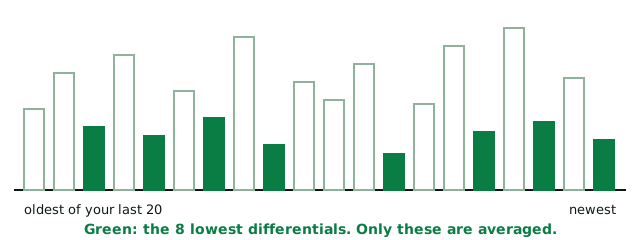
- Handicap Index = average of your lowest 8 differentials from your latest 20
- Course handicap = Handicap Index × (slope rating ÷ 113) + (course rating - par)
- Playing handicap = course handicap × handicap allowance
These all come from the Rules of Handicapping. The maximum index is 54.0. With fewer than 20 rounds, the rules use fewer differentials and sometimes take a little off:
| Rounds | Differentials used | Adjustment |
|---|---|---|
| 3 | Lowest 1 | -2.0 |
| 4 | Lowest 1 | -1.0 |
| 5 | Lowest 1 | None |
| 6 | Lowest 2 | -1.0 |
| 7 or 8 | Lowest 2 | None |
| 9 to 11 | Lowest 3 | None |
| 12 to 14 | Lowest 4 | None |
| 15 or 16 | Lowest 5 | None |
| 17 or 18 | Lowest 6 | None |
| 19 | Lowest 7 | None |
| 20 | Lowest 8 | None |
A worked example and what your result means
The calculator opens with eight example rounds, so you can follow along on screen. Eight rounds means the average of the lowest 2, which are 15.5 and 15.9. That gives a Handicap Index of 15.7. Round 2 (88) misses out while round 7 (89) counts, because an 89 on the harder course beats an 88 on the easier one.
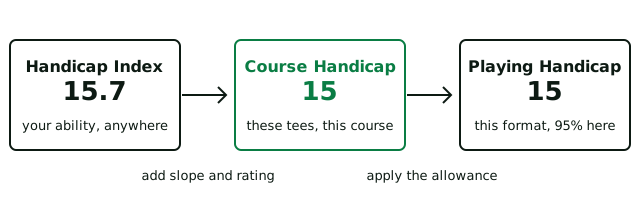
Now take a course with a rating of 70.1, a slope of 124 and a par of 72: 15.7 × (124 ÷ 113) + (70.1 - 72) = 15.33. Your course handicap is 15. The allowance goes on the unrounded figure, so a singles Stableford at 95% gives 14.56 and a playing handicap of 15. A four-ball Stableford at 85% gives 13.03, so you'd play off 13.
Because the index comes from your better rounds, you won't play to it most weeks. That's normal. See what counts as a good handicap for how yours compares, or put your playing handicap into our Stableford points calculator, where 36 points means you played to it.
One thing catches new golfers out: a better score can raise your index early on, because the adjustment shrinks as your record grows. England Golf's guidance gives the example of John, whose index of 20.1 came from a best differential of 22.1 and rose to 21.0 after a fourth round of 22.0.
Which number should you use?
Your index travels with you and a golf course handicap calculator converts it for one set of tees. Competition entry usually goes by index, while your shots on the day come from your playing handicap. In Great Britain and Ireland these allowances are mandatory, per England Golf's table:
| Format | Allowance |
|---|---|
| Singles stroke play or Stableford | 95% |
| Singles match play | 100% |
| Four-ball stroke play or Stableford | 85% |
| Four-ball match play | 90% |
| Foursomes | 50% of combined handicaps |
| Greensomes | 60% low, 40% high |
Why can this handicap calculator differ from your official index?
Your club's system knows things this page can't, so your official record is always the answer.
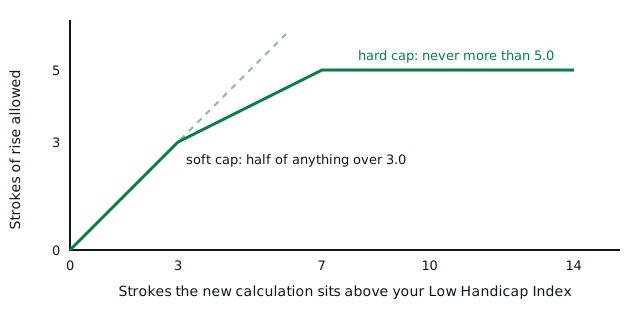
- Caps. Once you've 20 scores, your index is compared with your lowest in the past 365 days. Any rise above 3.0 strokes is cut by half and the total rise stops at 5.0.
- Exceptional scores. A differential 7.0 to 9.9 below your index takes 1.0 off your recent differentials. At 10.0 or more it takes off 2.0.
- Committee changes. Your club's handicap committee can adjust an index after a review.
- Old formulas. Some help pages show course handicap as index × slope ÷ 113, including England Golf's FAQ sheet. Its fuller guidance adds course rating minus par and so do we, which can move your figure by several shots.
Getting an official Handicap Index in the UK
You'll need 54 holes of scorecards for a handicap committee, with first scores capped at par plus 5 on any hole. In Great Britain and Ireland, every round must be registered before you tee off. Being in the draw or on a booking sheet doesn't count.
Join an affiliated club or, in England, take out an iGolf subscription from England Golf (under £50 when checked in November 2026).
The rounds you log are useful for more than your index. Our guide to the best golf apps covers scoring and stats, while a golf shot tracker shows which clubs are costing you shots. There's more in our free golf tools.
Your questions answered
How is a golf handicap calculated?
Each round becomes a score differential, using your adjusted gross score, the course rating, the slope rating and the day's PCC. Your Handicap Index is the average of your lowest 8 differentials from your latest 20.
How many rounds do I need for a handicap?
54 holes, which can be three 18-hole rounds, six 9-hole rounds or a mix.
Do social rounds count towards my handicap?
Yes, if you pre-register them and play by the Rules of Golf. Match play and most team formats don't count. Four-ball competition scores can.
Do my old scores expire?
No. A score counts for as long as it's one of your latest 20, however old it is.
What's the difference between course handicap and playing handicap?
Course handicap is your index converted for your tees. Playing handicap is that figure after the allowance for the format.
Where these facts came from
- The R&A's Rule 5: best 8 of 20, the 54.0 maximum, PCC, Low Handicap Index, soft and hard capschecked 3 November 2026
- The R&A's Rule 3: net double bogey and the par plus 5 limit on first scoreschecked 3 November 2026
- The R&A's Appendix C: how allowances apply and how match play strokes workchecked 3 November 2026
- Where to look up a course's rating and slopechecked 3 November 2026
- Score differential formula and roundingchecked 3 November 2026
- Table of differentials and adjustments for 3 to 20 roundschecked 3 November 2026
- Exceptional score reductionschecked 3 November 2026
- Course handicap formula and when it's roundedchecked 3 November 2026
- England Golf guidance for Great Britain and Ireland: course rating minus par, pre-registration, unrounded playing handicap sums, 9-hole scores, the John examplechecked 3 November 2026
- England Golf's mandatory handicap allowanceschecked 3 November 2026
- England Golf FAQ sheet: 54 holes for a first index, acceptable formats, competition entrychecked 3 November 2026
- iGolf subscription pricechecked 3 November 2026
- What iGolf is and who runs itchecked 3 November 2026
Spotted something out of date? Tell us and we'll fix it.