If you buy through our links we may earn commission, at no cost to you. How we choose and our disclosure
The best launch monitor for most UK golfers is the Garmin Approach R10: a small radar with more than a dozen metrics, an IPX7 water rating and wide simulator support for under £500. Spend less on the Shot Scope LM1 for core numbers or choose Square Golf if your room is short.
Every spec here comes from the maker, every price from a UK retailer or maker page opened on 2 November 2026 and every comment on accuracy from a named independent tester such as Golf Monthly or Breaking Eighty. Our how we choose page sets out the whole method. A golf launch monitor is a radar or camera that reads your club and ball at impact, then works out how far and where the shot went. Some are portable launch monitors you carry to the range. Others double as a golf simulator at home.
Three things most launch monitor guides skip
- The price on the box isn't the full price. Over five years one popular unit more than doubles once you add its plan.
- Room depth rules out more models than budget does. A radar can need more than 6m from the wall behind you to the net.
- A British garage in January is a real test. The Garmin R10 runs down to minus 10C but its manual says charge it above freezing.
The best launch monitor for each type of golfer
| Best for | Golf launch monitor | Why it's here | Know this first |
|---|---|---|---|
| Most golfers | Garmin Approach R10 | Broad data, tiny, water resistant, huge simulator choice | Many numbers are calculated. Radar needs a deep room |
| Best budget launch monitor | Shot Scope LM1 | Screen built in, no fees, numbers that held up against a GCQuad | No spin, no simulator, weaker indoors |
| Measured spin on a portable | Rapsodo MLM2PRO | Two cameras plus radar, impact video | Best features sit behind a yearly plan |
| Short rooms | Square Golf | Camera beside the ball, about 3m of depth, no subscription | Indoor only. No club speed or smash factor |
| Serious data, no fees | FlightScope Mevo Gen2 | 20 parameters, 8 courses you own, no yearly charge | Club path and face angle cost extra |
| All-in-one simulator | Garmin Approach R50 | 10 inch touchscreen, no PC or tablet needed | 4.1kg. Courses need a subscription |
How do you choose a golf launch monitor?
Answer three questions in this order: where will you hit, what will you do with the numbers and how much will you spend over the years you own it. Most people start with the third and buy the wrong thing. A launch monitor for range practice and one for a home simulator are often different machines, even when they share a brand.
Start with your handicap and what you'll really use
Golf Monthly's guide makes the point plainly: club path and spin axis might not even be relevant to a 25 handicapper. A newer golfer also gets a better return from lessons than from data, which we agree with. Good coaching will fix a slice faster than a graph of it will, so book that first and treat any golf launch monitor as the second purchase.
| Your golf | What you need the numbers for | Start with |
|---|---|---|
| Beginner or 25+ handicap | Lessons first, then how far each club really goes | Shot Scope LM1, once the lessons are booked |
| 13 to 24 handicap | Gapping your clubs, seeing why shots curve, winter fun | Garmin R10 |
| 5 to 12 handicap | Wedge distances, measured spin, path you can trust | Rapsodo MLM2PRO or Mevo Gen2 |
| Any handicap, short room | Playing courses at home through the winter | Square Golf |
| Any handicap, money no object | A family simulator that switches on and works | Garmin R50 |
Our golf club distance calculator gives you a starting chart to compare your new numbers against, while the swing speed chart shows what your club speed means for shaft flex.
Then measure the room
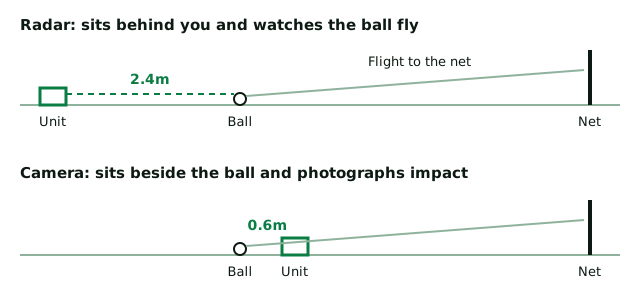
Radar and camera units want very different amounts of space. A radar launch monitor sits behind you and reads the ball in flight, which makes it a natural outdoor launch monitor. Camera units, also called photometric units, sit beside the ball and photograph impact, so they care far less about what's behind you. This one fact decides most home simulator setups.
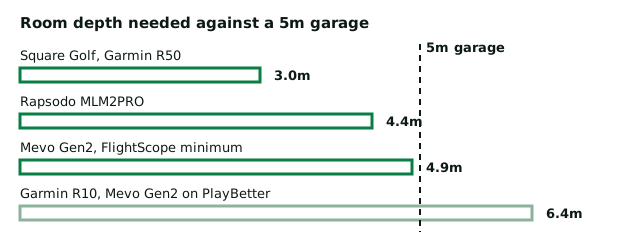
A worked example shows how much this matters. Say your garage measures 5m from the back wall to the door, with the net just inside the door. A 6.4m figure rules out the R10 on paper. FlightScope's own minimum for the Mevo Gen2 is lower at 16ft, or 4.9m: 8ft behind the ball and 8ft to the net. That just fits, with nothing to spare. The MLM2PRO fits on PlayBetter's figure and Square Golf fits with room left over.
Golf Monthly's R10 review sets the unit about 6ft behind the ball, so a shorter radar setup is possible in a pinch, but you give up net distance and the margin for error. Ceiling height decides a lot too. FlightScope asks for 9ft as the bare minimum and 10 to 12ft for comfort. Swing your driver slowly in the room before you spend anything, because no launch monitor setup survives a club through the ceiling. Our simulator room and cost planner runs these sums for your own spare room or garage.
Think about the British weather
None of the top search results we read for this keyword talks about charging in the cold. Here's what the makers' spec sheets say for a damp UK range or an unheated garage:
| Model | Water rating | Temperature | Where it works |
|---|---|---|---|
| Garmin R10 | IPX7, brief immersion | Runs from -10C to 55C, charges from 0C to 45C | Indoors and outdoors |
| Shot Scope LM1 | IPX3, rain | Runs from -10C to 50C | Indoors and outdoors |
| Garmin R50 | IPX3, rain | Not on the UK page | Indoors and on the range |
| Square Golf | Not waterproof | Not listed | Indoors, out of direct sunlight |
| MLM2PRO, Mevo Gen2 | Not listed | Not listed | Indoors and outdoors |
So bring the R10 inside to charge it on a frosty night. If a maker doesn't list a water rating, treat that unit as one to keep dry and don't assume otherwise.
The six best golf launch monitors for UK golfers
Each pick below has a job. We've chosen a best golf launch monitor for a type of golfer and not one winner for everyone, because a launch monitor that suits a deep garage can be useless in a box room. The spec box under each pick lists the price and where to see it.
Best for most golfers: Garmin Approach R10
Golfers with a net, a deep garage or a garden who want plenty of data and the choice to play courses.
The R10 keeps turning up in other people's lists of the best golf launch monitor for a reason. Garmin lists 14 metrics from a unit weighing 148g, with up to 10 hours of battery and a tripod, phone mount and carry case in the box. PlayBetter, a US retailer that sells these units, calls it the safe pick and praises its broad simulator choice: Home Tee Hero, GSPro, E6 Connect and Awesome Golf all work with it. Golf Monthly's review found carry distances that matched its on-course shot data when using proper golf balls and liked it most in a net.
Here's why it beats the dearer portable launch monitors for most people: you pay for the unit, then decide later whether you want a home simulator membership at all. The driving range practice mode works without one, so it's good value even if you never play a virtual course.
- IPX7 is the best water rating in this guide
- 43,000 courses through Home Tee Hero, if you add the membership
- Records swing video on your phone with the stats on top, though storing clips needs the membership
- PlayBetter reports only four metrics are directly measured, with the rest calculated
- Golf Monthly's 2022 review found range balls warped its distance data, so it suits a net with real balls better than a busy range
- No screen, so you need a phone or tablet. PlayBetter wants 6.4m of depth indoors
Best budget launch monitor: Shot Scope LM1
Range regulars who want honest carry numbers without an app, a tablet or a yearly fee.
The LM1 does less on purpose. It shows club speed, ball speed, smash factor, carry and total on its own 3.5 inch colour screen, then syncs to a free app. Golf Monthly compared it with a Foresight GCQuad on the same shots, then checked three 9-irons with a laser where they landed. The LM1 was never more than 3 to 4 yards out. That's a useful result for a cheap launch monitor when the GCQuad's RRP runs to five figures.
If gapping your irons is the whole job, you don't need any other launch monitor. It also has a speed training mode for swing practice.
- No subscription and no calibration, by Shot Scope's account
- Sits just 1.5m behind the ball, so it asks for little space behind you
- Comes with a protective carry case
- No spin or path, no simulator and no virtual courses
- Golf Monthly says it struggled indoors on shots with a lot of curve, which matters to high handicappers with a home net
- PlayBetter's reviewer got a wildly wrong reading on one snap hook
Best for measured spin: Rapsodo MLM2PRO
Better players who want to see the clubface at impact and will pay yearly for the full package.
Two cameras plus Doppler radar mean the MLM2PRO reads things the R10 has to work out. Rapsodo says 8 of its 15 metrics are measured, including spin rate, spin axis, angle of attack and club path. PlayBetter's reviewer says it tracked nearly identically to a Foresight GC3 and calls it the most accurate portable under the $1,000 mark. Golf Monthly rates it among the easiest to set up. The slow motion impact video is the feature that sets this launch monitor apart at the price.
The catch is the plan. Rapsodo's UK membership table shows 11 metrics free, with all 15, the impact video and the 30,000 courses on a yearly Core plan. There's no monthly payment.
- Works indoors and outdoors with a tripod and carry case in the box
- Needs less room than a pure radar on PlayBetter's figures
- Newer MLM2XPRO at Scottsdale Golf adds tracked putting in the simulator
- Older reviews mention a free first year. Rapsodo's UK page now shows a trial of 21 days in one place and 45 in another, so check before you buy
- Measured spin needs the Core plan and RPT golf balls, sold separately beyond the three in the box
- Don't buy it and skip the plan, because you'd be paying for hardware you can't fully use
Best for short rooms: Square Golf
Anyone building a winter setup in a spare room or small garage who won't take it to the range.
Square Golf is a camera unit, so it sits beside the ball and PlayBetter puts its room depth at about 3m. Scottsdale Golf lists ball speed, direction, launch angle, spin, apex, carry, run and total, plus swing path, face angle, dynamic loft and angle of attack. Courses, a driving range, putting and closest-to-the-pin games are built in, with 1,000 credits included. Golf Swing Systems says that's enough for more than 55 rounds.
PlayBetter calls it the buy for a tight budget and a tight room. For a home simulator in a room that can't fit a radar launch monitor, nothing here makes more sense. Setup is simple too: the ball sits 42cm from the unit, according to the instructions on SimSpace Golf's page.
- No subscription, with third-party options including GSPro
- Up to 8 hours from a removable battery
- A swing stick for practice where a real swing won't fit
- Indoor only, not waterproof and it must stay out of direct sunlight
- PlayBetter says it misses clubhead speed and smash factor
- Spin relies on its dotted balls and PlayBetter says full club data needs shaft stickers. Left and right handers can't share it without moving the unit
Best for serious data with no fees: FlightScope Mevo Gen2
Keen golfers who practise on the range and at home and hate subscriptions.
Breaking Eighty names the Mevo Gen2 its overall favourite while PlayBetter says the numbers are very accurate for the price. FlightScope claims 20 parameters with no calculated estimates, using radar plus high-speed optics. All core data is free with no yearly charge. You also own 8 E6 Connect courses and get 100 aluminium stickers for indoor spin readings.
OpenGolfer, which sells these to fit in garden cages, says radar units like this want roughly 2.4m behind the ball, so plan the mat position before you buy. It's the launch monitor to choose if you want numbers to build a practice plan around for years, on the range or in a home simulator.
- Up to 6 hours of battery with USB-C
- Records swing video with data on top
- Handles left and right handers without moving, as radar does
- OpenGolfer says club path and face angle need the paid Pro Package upgrade, non-refundable once activated, so buy the unit first and add it later
- Indoors you need stickers or Titleist RCT balls for accurate spin
- Sold through other UK retailers, including Hotgolf
Best all-in-one launch monitor and simulator: Garmin Approach R50
Households who'd pay more so that nobody has to pair a tablet or run a gaming PC.
This is Golf Monthly's top pick and it's a different animal from the others. Three high-speed cameras read club and ball directly while a 10 inch touchscreen shows the data or a full course. Up to four players can play Home Tee Hero on more than 43,000 courses straight from the unit, or you can plug a projector into the HDMI socket. Breaking Eighty says there's nothing quite like it among launch monitors, which makes comparing it with the others hard.
- Works with every club including putters, says Garmin
- Asks for about 3m of depth, far less than the radars
- Built-in barometer adjusts carry for where you are
- Garmin says it isn't available for delivery to Northern Ireland
- 4.1kg is portable only in the sense of moving it between car and bay. Battery lasts up to 4 hours
- Golf Monthly's main gripe is kneeling down to change settings. Club data needs the stickers and courses need a subscription
Launch monitor comparison
Here are all six side by side, with the same specs for each launch monitor. Pick two and compare them, or use the wider golf gadget comparison tool for other kit.
What does a golf launch monitor cost over five years?
Nobody in the top search results adds up the full cost of a golf launch monitor in pounds, so here it is. We've taken the price when checked on 2 November 2026, some of it Black November sale pricing, then added five years of whatever you'd need for simulator golf or full data.
| Model | Unit when checked | Yearly plan | Five-year total |
|---|---|---|---|
| Shot Scope LM1 | £189.99 | None | £189.99 |
| Square Golf | £679 | None, extra credits only if you run out | £679 and any credits |
| Garmin R10 | £429.99 | Garmin Golf membership, £89.99, optional | About £880 with the membership |
| FlightScope Mevo Gen2 | £1,019 | None. Pro Package is a one-off extra | £1,019 |
| Rapsodo MLM2PRO | £549.99 | Core plan, £159.99 | £1,349.94 |
| Garmin R50 | £4,299.99 | Garmin Golf membership for courses, £89.99 | About £4,750 with the membership |
The Garmin totals use the yearly price on the Garmin Golf listing in the UK App Store. Paying monthly costs £8.99, which comes to more. The Mevo total leaves out its add-ons: PlayBetter says full club data and face impact location retail for about $1,500 in the US and often sell for as little as $850. Third-party software such as GSPro or E6 Connect costs extra on any of these.
The surprise is the middle of the table. Across five years the base Mevo Gen2 costs less than the MLM2PRO despite nearly double the price on the box, though the MLM2PRO's plan includes club path and the base Mevo doesn't. If you plan to keep paying for a simulator, the cheaper unit can be the dearer one. If you'd cancel after a winter, it's the other way round. Good value depends on how long you'll keep paying, so decide that before you compare any launch monitor price.
What the golf launch monitor specs mean
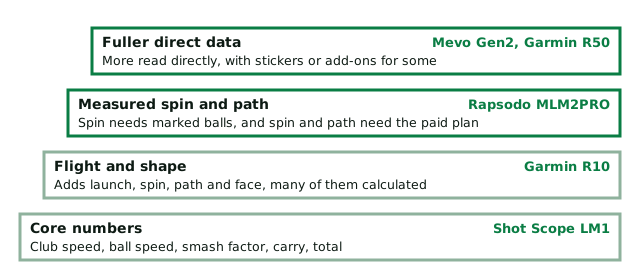
Every launch monitor brochure lists a long row of numbers, so the question that matters is which were measured and which were worked out from others. Our launch monitor numbers guide goes through each one, but this is the short version.
- Club speed and ball speed are how fast the head and ball are moving. Smash factor is ball speed divided by club speed, so it shows how well you found the middle.
- Carry distance is the flight before the ball lands. Total distance adds the run. Use carry when you're gapping an iron or a wedge.
- Launch angle and spin rate explain why a shot balloons or drops. Golf Monthly defines spin axis as the tilt of the ball's spin. The nearer it is to 0, the straighter the shot.
- Club path and face angle explain the curve. These are the numbers that tell you why you slice.
- Angle of attack is whether the club is moving up or down at impact. Handy with a driver.
No launch monitor reading is perfect. Breaking Eighty's advice is that a lot of poor readings come from setup: position, alignment and the room itself. It says every device on its list can give pretty inaccurate results when the setup is wrong, so fix that first if your numbers look daft.
There's a second check that costs nothing. Hit ten shots with one club and look at the spread, then do it again next week. A launch monitor earns its keep through trends across a practice session, not one heroic reading. That's as true of a cheap launch monitor as of a Trackman.
The mistakes people make when buying a launch monitor
- Buying before measuring. Tape the room first, including the ceiling.
- Comparing the box price. Add the plan, as the table above does, or you'll misjudge the value of a budget launch monitor.
- Forgetting the mat and net. Every home simulator setup needs a net or impact screen plus a surface worth hitting from. Our guide to golf hitting mats covers what suits a garage. Our page on the best home golf simulators covers full setups.
- Assuming any ball will do. Rapsodo needs RPT balls for measured spin, Square Golf uses dotted balls and the Mevo needs stickers or RCT balls indoors.
- Expecting it to fix your swing. It shows you what happened. For the motion itself, a golf swing analyser or a coach helps more.
- Using it on the course. Breaking Eighty says a launch monitor rarely makes sense there, as it's cumbersome to carry and set up. Its one exception is the Garmin G82, a handheld GPS with a launch monitor built in.
Which launch monitors did we leave out and why?
Plenty of good launch monitors missed the list. Their reasons may not apply to you, so here they are.
- Trackman 4 and Foresight GCQuad: the tour standards. Golf Monthly puts both at five figures, so they're for coaches and fitters.
- Foresight GC3, Bushnell Launch Pro, Uneekor Eye Mini and Full Swing KIT: all respected, all well above most home budgets. Breaking Eighty calls the Launch Pro the most accurate it has tested. Scottsdale Golf lists the Launch Pro and Full Swing KIT.
- SkyTrak+ and ST MAX: Breaking Eighty likes these for the home and for Mac users, but warns that GSPro and E6 are no longer directly supported.
- Swing Caddie SC4 Pro: PlayBetter's case for it is a built-in screen, free E6 Connect courses and no subscription. It's a fair alternative to the R10 if you hate subscriptions.
- Blue Tees Rainmaker: PlayBetter reports about a six-second wait for each shot's data and poor indoor spin for now.
- PRGR: Golf Monthly's pick for a pocket unit at 125g, though it has no app and only logs your last 500 shots. Scottsdale Golf stocks it, but the LM1's app and session history won the budget spot.
- Square Omni: the outdoor-capable Square, with four cameras. Golf Monthly found it matched a GC3 indoors but less so in sunlight. Hotgolf lists it at more than double the price of the indoor model, so it isn't the short-room pick.
If you're after kit in other categories too, our round-up of the best golf gadgets sets out what to buy first for each type of golfer.
The bottom line
- Have the room and want one do-it-all launch monitor? Buy the Garmin R10.
- Only want honest yardages? The Shot Scope LM1 is the cheap launch monitor to get.
- Short room and a winter home simulator in mind? Square Golf.
- Keeping it for years with no fees? FlightScope Mevo Gen2.
Your questions answered
What is the best launch monitor under £500?
The Garmin Approach R10 for most golfers, because it adds spin, launch and path data plus simulator support. If you only want carry and speed, the Shot Scope LM1 costs much less and has its own screen.
Are cheap launch monitors accurate?
For speed and carry, often yes. Golf Monthly found the Shot Scope LM1 within 3 to 4 yards of where three 9-irons really landed. The weak points are mishits, curved shots indoors and spin, which budget units leave out or calculate.
Is a launch monitor worth it for a high handicapper?
Usually not as a first spend, since Golf Monthly's advice is that newer golfers get more from coaching. A cheap unit can still help you learn your real distances, which saves shots without changing your swing.
Radar or camera: which launch monitor type should I buy?
Choose radar for the range and for deep rooms, because it watches the ball fly. Choose a camera unit for short rooms, because it sits beside the ball. Hybrids like the Rapsodo MLM2PRO mix the two. Whichever you pick, measure the room first.
How much room do I need for a launch monitor at home?
PlayBetter recommends about 3m of depth for camera units, 4.4m for the MLM2PRO and 6.4m for the Garmin R10. FlightScope's minimum for its Mevo Gen2 is 4.9m. Allow at least 9ft of ceiling height and test your driver swing first.
Do launch monitors need a subscription?
Not all of them. The Shot Scope LM1, Square Golf and Mevo Gen2 have no required yearly fee, while the Garmin R10 and R50 need a membership for Home Tee Hero courses and the Rapsodo MLM2PRO keeps its best features on a yearly plan.
Where these facts came from
- Golf Monthly's picks, spin axis definition, advice on handicap and coaching, Trackman 4 cost, R50 and Square Omni commentschecked 2 November 2026
- The Shot Scope LM1 compared with a GCQuad, the 3 to 4 yard result, indoor struggles and the GCQuad RRPchecked 2 November 2026
- R10 accuracy with proper balls, range ball problem and the 6ft setupchecked 2 November 2026
- MLM2PRO battery life of two to four hours and ease of setupchecked 2 November 2026
- PRGR weight, no app connection and 500 shot memorychecked 2 November 2026
- PlayBetter's comments on the R10, LM1, MLM2PRO, Square Golf, Mevo Gen2, Swing Caddie SC4 Pro and Blue Tees Rainmakerchecked 2 November 2026
- Room depth for each model and sharing a camera unit between left and right handerschecked 2 November 2026
- Breaking Eighty's overall favourite, setup advice, on-course use, SkyTrak and Launch Pro commentschecked 2 November 2026
- Radar and camera placement in a UK garden cage, what the Pro Package adds and its refund rulechecked 2 November 2026
- Garmin Approach R10 specs, metrics and the membership needed for Home Tee Herochecked 2 November 2026
- Garmin R10 running and charging temperatures, water ratingchecked 2 November 2026
- Simulator apps that work with Garmin launch monitorschecked 2 November 2026
- Garmin Approach R50 price, specs, delivery note and featureschecked 2 November 2026
- Shot Scope LM1 specs, position behind the ball, temperature range, warrantychecked 2 November 2026
- MLM2PRO UK price, metrics, RPT balls, trial lengthchecked 2 November 2026
- Rapsodo UK membership price and what each tier includeschecked 2 November 2026
- Mevo Gen2 specs, parameters, included courses and no yearly feechecked 2 November 2026
- FlightScope's 16ft minimum depth and ceiling height advicechecked 2 November 2026
- Mevo Gen2 UK price and the Square Omni pricechecked 2 November 2026
- Garmin R10 UK pricechecked 2 November 2026
- Shot Scope LM1 UK pricechecked 2 November 2026
- Square Golf UK price and data listchecked 2 November 2026
- MLM2XPRO on sale in the UKchecked 2 November 2026
- Square Golf credits, battery, size and indoor usechecked 2 November 2026
- Square Golf not waterproof and avoiding direct sunlightchecked 2 November 2026
- Garmin Golf membership price in the UKchecked 2 November 2026
- Connecting a projector to the R50's HDMI outputchecked 2 November 2026
- PRGR on sale in the UKchecked 2 November 2026
- Bushnell Launch Pro on sale in the UKchecked 2 November 2026
- Full Swing KIT on sale in the UKchecked 2 November 2026
Spotted something out of date? Tell us and we'll fix it.